The 1980s board games era was truly extraordinary, with classics like Trivial Pursuit and Risk each selling over 100 million copies worldwide. I wish I was born in the 80s to remember gathering around the table with friends and family, eagerly setting up colorful game boards that promised hours of entertainment without a single pixel in sight.
Popular 1980s board games offered something for everyone. While Trivial Pursuit challenged our knowledge across six distinct categories, games like Dark Tower incorporated groundbreaking electronic elements, and HeroQuest sold over 2 million copies with its dungeon-crawling adventures. In fact, the diversity was astounding, from the shopping-themed Mall Madness with its electronic console to the strategic world domination of Axis & Allies.
These weren’t just cardboard and plastic; they were portals to different worlds. Games like Talisman promised unpredictable gameplay through “lots and lots of cards”, while Careers let players collect fame, happiness, and fortune to match their starting aspirations. There was also The Gambler, described perfectly as “the ‘kiddie cocktail’ of board games”, the perfect primer for kids playing at being adults.
Join me as we roll the dice and travel back to a time when board games weren’t just played, they were experienced. From strategy to trivia, fantasy to family fun, these tabletop treasures defined an era and created memories that have lasted far longer than their cardboard components.

Iconic Board Games That Defined the 80s
The 1980s witnessed the birth of several board games that became household staples across America. These weren’t simply pastimes, they transformed living rooms into competitive arenas where families and friends created lasting memories.
Trivial Pursuit: The trivia game that took over living rooms
Conceived in December 1979 by two Canadian friends, Chris Haney and Scott Abbott, during a casual game of Scrabble. The game officially launched in 1981 and quickly became a cultural phenomenon. By 1984, just three years after its debut, gross sales had reached over half a billion dollars, with an astonishing 20 million copies sold that year alone.
The original edition featured 6,000 trivia questions on 1,000 cards organized across six categories including History, Science and Nature, and Entertainment. Players navigate a wheel-shaped board collecting colored wedges by correctly answering questions, aiming to fill their playing piece and answer a final question to win. The game’s nostalgia factor particularly appealed to Baby Boomers, making their “golden years seem vital, even historic”.
Guess Who?: A face-off in deduction
Released in 1982, Guess Who? brought deductive reasoning to family game night. This two-player mystery game featured 24 characters with distinctive facial features. Players select a mystery person and take turns asking yes/no questions about physical characteristics: “Does your person have blue eyes?” or “Is your person wearing a hat?”. With each answer, players eliminate possibilities by flipping down character cards until only one remains.
The game’s brilliance lies in its simplicity, asking strategic questions that eliminate multiple options simultaneously creates a satisfying mental challenge. Additionally, speech therapists have embraced the game for teaching articulation, comprehension, and question-response skills.
Pac-Man: From arcade to tabletop
Following the arcade sensation, Coleco released a tabletop Pac-Man game in 1981 using VFD technology (similar to LCD). This adaptation featured three gameplay modes: traditional Pac-Man, Head-to-Head Pac-Man for two players, and a unique Eat & Run mode.
Furthermore, the 1982 board game version allowed players to control either Pac-Man or the ghosts. Perhaps its most remarkable feature was the mechanically ingenious Pac-Man playing pieces—they actually “ate” marbles by opening their jaws and pressing down on the game pieces. Despite their somewhat terrifying appearance with “jagged teeth” that barely resembled the video game character, these pieces made the physical game engaging, particularly for children.
Strategy and War Games That Challenged the Mind
Strategy games dominated a significant corner of the 1980s board game market, offering players complex challenges that went beyond simple dice rolls and card draws.
Axis & Allies: World War II on your table
Originally published in 1981 and re-released as “Classic” in 1984, Axis & Allies brought global warfare to living rooms across America. Players controlled major WWII powers: Germany and Japan for the Axis, and the Soviet Union, United Kingdom, and United States for the Allies. The game’s appeal stemmed from its intricate balance of military strategy and resource management using “Industrial Production Certificates” representing one million man-hours of labor. Moreover, the game featured detailed plastic miniatures representing infantry, armor, fighters, bombers, battleships, and more. Consequently, this detailed simulation sold millions of copies, cementing its place in strategy game history.
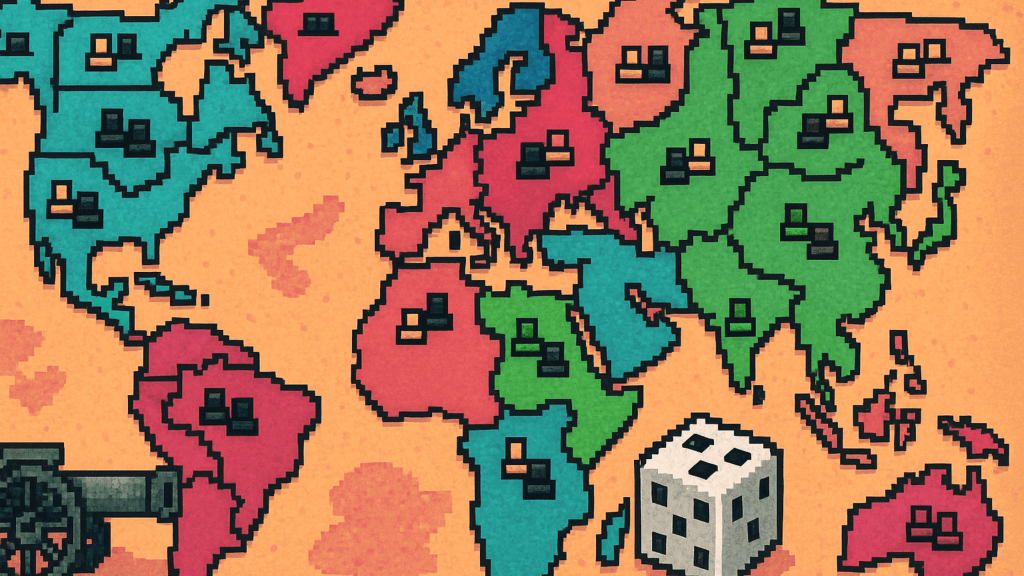
Risk: Global domination with dice
Risk became a phenomenon in the 1980s, selling over 100 million copies worldwide. The game’s brilliance lay in its deceptively simple premise: conquer territories and eliminate opponents, yet it offered profound strategic depth. Players learned that controlling continents like North America (with its 5-troop bonus and only 3 borders) often proved more valuable than Australia’s easier-to-defend but limited-bonus territories. Furthermore, understanding the statistical advantage of attackers when rolling maximum dice became crucial for seasoned players.
Conquest of the Empire: Roman warfare in a box
Released in 1984 as part of Milton Bradley’s Gamemaster Series, Conquest of the Empire transported players to Ancient Rome. The game featured beautifully detailed components including legions, cavalry, catapults, and ships . Players competed as Roman generals vying for power, employing military might and political maneuvering through Senate votes. Indeed, the 2005 reissue included two rule sets: the original (with fixed catapult rules) and a newer system based on “Struggle of Empires”.
Fortress America: Defend the homeland
This 1986 release featured asymmetrical gameplay where one player defended the United States against three invading forces. The defender controlled laser towers with unlimited range that activated progressively throughout the game. Meanwhile, invaders controlled conventional forces that needed to capture 18 cities to win. Nevertheless, the defender-favored combat system (where defenders fired first, removing casualties before attackers could respond) created tense, strategic battles.

Fantasy and Adventure Games That Sparked Imagination
Fantasy and adventure swept through the tabletop gaming world of the 1980s, transporting players to magical realms filled with heroes, monsters, and epic quests.
HeroQuest: Dungeon crawling for beginners
Released in 1989, HeroQuest served as a gateway to more complex role-playing games, selling over 2 million copies worldwide. Players chose from four classic character archetypes: Barbarian, Dwarf, Elf, and Wizard, each with unique abilities. Unlike traditional RPGs, HeroQuest featured detailed miniatures and a modular board that created endless replayability. Essentially, the game brilliantly combined elements of role-playing games in an accessible board game format, encouraging strategic thinking through its straightforward yet engaging dice-driven gameplay.
Talisman: A magical quest for the Crown
Originally released in 1983, Talisman invited players on a perilous journey to obtain the Crown of Command. The game board was divided into three regions (Outer, Middle, and Inner), with characters gradually building strength before attempting the final challenge. By 2000, Talisman had sold over 800,000 units. Notably, players needed to find a Talisman card before entering the Valley of Fire, making the game’s name central to its winning strategy.
Dragonlance: Board game meets novel
Based on the popular novels by Margaret Weis and Tracy Hickman, Dragonlance (1988) blended intricate storytelling with tactical gameplay. Set in the Dungeons & Dragons universe, this game immersed players in epic quests against dragons and mythical creatures.

Family and Party Games Everyone Played
Party games brought laughter and friendly competition to 1980s gatherings, with titles that emphasized creativity and quick thinking over strategy.
Pictionary: Drawing your way to victory
Released in 1985, Pictionary transformed charades by adding pencil and paper to the mix. Players race against a 60-second timer to illustrate words or phrases for teammates to guess. The game requires no artistic skill, just the ability to convey concepts through simple sketches. Teams move across the board by correctly guessing drawings, with different categories adding variety to each round.
Balderdash: Bluffing with words
This clever 1984 reimagining of the parlor game Dictionary challenged players to create convincing fake definitions for obscure words. Points are awarded when opponents believe your made-up explanation is the genuine definition. The best bluffs sound authoritative yet plausible, neither too detailed nor suspiciously vague.
Outburst: Shouting out answers under pressure
Outburst (1986) tests how quickly teams can brainstorm answers to specific topics. Teams have just 60 seconds to shout out as many of the 10 pre-listed answers as possible. Topics range from “Cars Rich People Drive” to “Famous Dogs,” creating a frantic atmosphere as players race against the clock.
Taboo: Say everything but the word
Hasbro’s 1989 release Taboo quickly became a party staple. Players must get teammates to guess a word without using five “taboo” related words. For instance, describing “bicycle” without saying “ride,” “pedal,” or “wheels” forces creative communication. Each forbidden word earns a buzz from the opposing team’s scorekeeper.
Conclusion
The board games of the 1980s certainly left an indelible mark on our collective memory. Whether we were testing our knowledge with Trivial Pursuit, strategizing world domination in Risk, or frantically drawing clues in Pictionary, these games brought us together in ways that digital entertainment rarely achieves today.
Looking back at these tabletop treasures, I’m struck by their remarkable diversity. From the intellectual challenge of deduction games to the imaginative worlds of fantasy adventures, the 80s truly offered something for every type of player. Additionally, many of these classics continue to influence modern game design, with titles like HeroQuest paving the way for today’s complex dungeon crawlers.
Perhaps most importantly, these games created shared experiences. Unlike video games where players often stare at separate screens, board games gathered us around the same table, rolling dice, moving pieces, and making memories face-to-face. Therefore, their legacy extends beyond mere entertainmen, they helped shape our social connections.
Though technology has transformed gaming in countless ways since the 1980s, the enduring appeal of these classics speaks to their brilliant design and timeless fun. After all, there’s still something undeniably special about opening a colorful box, setting up a board, and embarking on an analog adventure with friends and family.
The next time you find yourself scrolling through endless digital options, consider dusting off one of these vintage treasures instead. Because while pixels and processors come and go, the joy of shouting “Balderdash!” or finally conquering Australia in Risk remains just as sweet as it was back in 1985.
 Topazzi World
Leave a comment